TL;DR What is AEO? AI tools like ChatGPT, Google AI Overview, and Perplexity are changing how customers find businesses. Answer Engine Optimization (AEO) is the practice of structuring your business so AI can find, understand, and cite you. Most small businesses haven’t addressed this yet. The foundational steps are practical, low-cost, and doable this week.
If you’ve noticed that more of your customers are finding you through word of mouth lately and less through search, part of what’s happening is a shift in how people look for businesses online.
Search hasn’t gone away, but a growing number of people are skipping the results page entirely and typing their questions directly into AI tools. ChatGPT. Google’s AI Overview. Perplexity. Bing Copilot. These tools don’t return a list of links. They generate a direct answer, and that answer names specific businesses.
Getting your business into those answers is what AEO is about.
What is AEO?
AEO stands for Answer Engine Optimization. Where SEO focuses on ranking in search engine results, AEO focuses on being cited in AI-generated answers.
The mechanics are different. Search engines rank pages based on keywords, backlinks, and authority signals. AI answer engines synthesize information from across the web and generate a response. They pull from businesses that are clearly described, consistently listed, and credibly mentioned in multiple places. Businesses that are vague, inconsistent, or hard to find in structured sources tend to get left out.
Why You Need to Pay Attention to AEO
A few numbers worth knowing:
Over 100 million people use ChatGPT monthly. Google’s AI Overview appears at the top of results for roughly 50% of queries. Studies consistently show that users trust AI-generated answers at higher rates than traditional search results.
Most small businesses have not done anything specific to optimize for AI search. That’s actually an opportunity. The businesses that address AEO in the next 12 to 18 months will build visibility that compounds over time and becomes harder for competitors to displace.
Read more AEO Statistics for 2026 here
The Five Things AI Engines Need
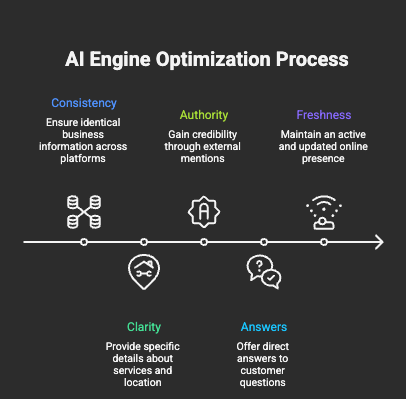
AI answer engines don’t pull from businesses randomly. They favor sources that are structured, consistent, and credible. Here’s what that looks like in practice.
- Consistency. Your business name, address, and phone number need to be identical across every platform where you’re listed: your website, Google Business Profile, Yelp, Facebook, and industry directories. When AI engines cross-reference your information, and it matches, it signals reliability. Discrepancies cause them to hedge or skip you.
- Clarity. AI engines are matching businesses to questions. A homepage that says “we help businesses thrive” doesn’t match much of anything. A homepage that says “we provide digital marketing strategy for small businesses and nonprofits in Metro Detroit” is specific enough to match. Your About page and homepage need to answer three things plainly: what you do, who you serve, and where you operate.
- Authority. External mentions matter. When your business appears on credible outside sources, such as a local publication, an industry directory, a partner’s website, a chamber of commerce listing, it increases how much AI engines trust your information. You don’t need national press. A handful of relevant, credible external mentions makes a real difference.
- Answers. AI engines are literally looking for answers to questions. When your website content directly answers something a customer might ask, in clear, complete sentences, you become a citable source. Three to five well-written pieces of answer content can meaningfully improve your AI visibility: an FAQ page, a service description written in plain language, a blog post that addresses one specific question.
- Freshness. Active businesses show up more reliably than dormant ones. Regular posts to your Google Business Profile, updated service pages, and timely responses to reviews all signal that your business is current and operating.
A full breakdown of each of these, including specific fixes, can be found in our Quick-Start guide.
The One Piece of Content That Has the Most Impact for AEO
Your AI-ready business description is the highest-leverage thing you can write.
AI engines pull heavily from business descriptions, particularly from your Google Business Profile, your website’s About section, and your homepage. When those descriptions are vague or inconsistent, there’s nothing for AI to work with. When they’re specific and consistent across platforms, AI can use them directly.
A good description covers what you do, who you serve, where you operate, what makes you different, and what your ideal client is trying to accomplish. Keep it under 750 characters, the Google Business Profile character limit, and leave out URLs. Once written, place it on Google, your homepage, your About page, LinkedIn, Facebook, and any directories where you have a profile. Consistency across those sources is what establishes you as a real, established business in AI’s view.
How AEO and SEO Work Together
AEO doesn’t replace SEO. The two practices share a foundation. A well-structured website, quality content, and credible backlinks improve both your search rankings and your AI visibility. If you’ve invested in SEO, that work carries over. AEO builds on top of it.
The main additions AEO requires are structured question-and-answer content and consistent information across platforms. Both are things most small businesses can address without a developer or a large budget.
Where to Start With AEO
Run an audit first. Before making any changes, find out where your business currently stands in AI search.
Open ChatGPT, Google AI, Perplexity, and Bing Copilot. Ask each one: “Who are the best [your service] in [your city]?” Then ask: “Tell me about [your business name].” Write down what comes back. Pay attention to whether your business appears, whether the information is accurate, and whether a competitor shows up where you should be.
From there, the priority order is: fix your NAP consistency, write your AI-ready business description, update your website’s core pages, and publish one piece of answer content. Each of those tasks takes 30 to 45 minutes.
Get the Step-by-Step Guide
The Basics of AEO: Quick-Start Guide walks through the entire process — the audit, the five things AI engines need, a fill-in-the-blank description template with a completed example, and a 7-day action plan. No task takes more than 45 minutes.
Kendra Malloy is the founder of Joyfire, a digital marketing and business coaching firm in Metro Detroit. Joyfire helps small businesses, entrepreneurs, and nonprofits clarify their marketing and grow revenue.